
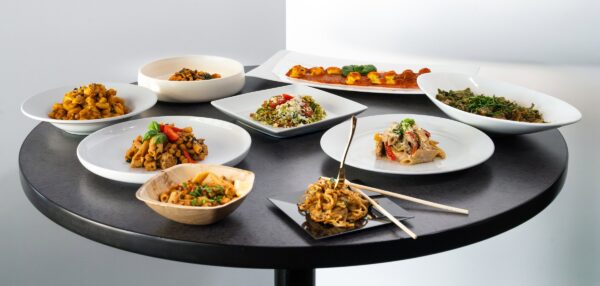
This year marked the 10th anniversary of NASA’s HUNCH Culinary Challenge, a food science and culinary competition for high school students held at NASA’s Johnson Space Center (JSC) in Houston, Texas. The stakes are higher than sky high in this annual contest, where the grand prize is the winning dish produced for astronauts aboard the International Space Station (ISS). Finalists from 10 schools—nine American, one from Luxembourg—gathered in April in Houston to face a panel of 24 (!) judges who would determine which signature dish was truly “out of this world.” This year’s theme was pasta, and the recipes developed had to meet strict nutrition requirements, all while providing appealing flavor profiles and navigating the challenges unique to long-term food preservation in outer space.
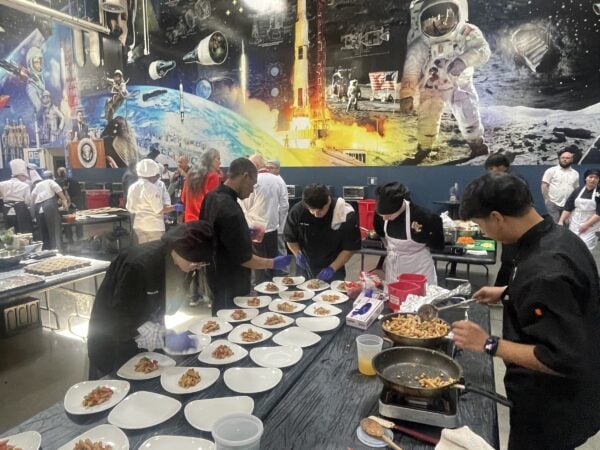
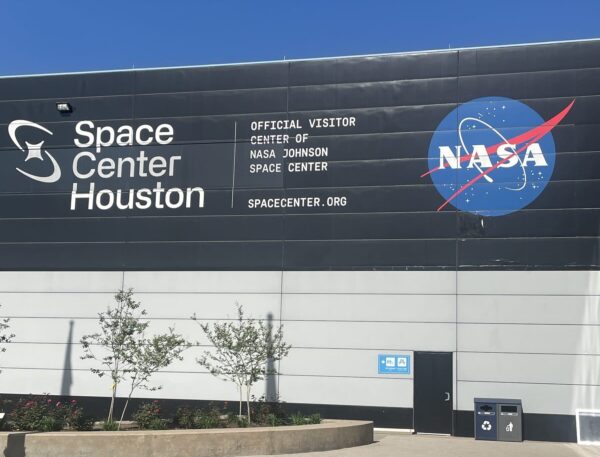 If you happened to visit the Food Lab Market & Eatery at NASA’s Johnson Space Center on April 8, you might have—just for a moment—believed you’d wandered onto a Master Chef tv set. That day visitors at the JSC Food Lab would find the food court transformed into a full-scale culinary competition space complete with 10 cooking and staging stations, and a judges’ table set with an intimidating 24 place settings. In the center of each setting was an evaluation sheet which, once completed, would determine the winner of the 10th Annual NASA HUNCH Culinary Challenge.
With judging set to start at noon on a sunny Tuesday in April, the 10 teams of finalists had just two hours to prepare their dishes. Students in chef’s hats and jackets huddled at workstations with their faculty advisers as they reviewed checklists, kneaded pasta dough, sliced vegetables and prepped their meals for plating and service. You could hear the occasional chorus of “Yes, Chef!” as instructions were given and received, while the students’ families and friends (and a few curious tourists) looked on.
The competition clock was ticking, and in no time at all it was time to determine “the next best dish in space” for ISS astronauts.
What’s a HUNCH?
HUNCH stands for High School Students United with NASA to Create Hardware. In addition to the culinary program, HUNCH has student programs in software, biomedical science, hardware and more. According to their website, “The HUNCH mission is to empower and inspire students through a project-based learning program where high school students learn 21st century skills and have the opportunity to launch their careers through participation in the design and fabrication of real-world valued products for NASA.”
 The 2025 HUNCH Culinary Challenge started with a field of 64 teams that initially competed in local contests. The top 10 scoring teams from these contests were then invited to Houston to cook and present their dish to the judges. The judging panel included food scientists from the NASA Johnson Space Center Food Lab, astronauts, guest chefs, NASA administrators and scholarship partners. Among the guest judges was Houston chef Emmanuel Chavez, whose restaurant Tatemó recently earned a Michelin star (among the first batch of Michelin stars awarded in the entire state of Texas); Chavez is also a 2025 James Beard Award semifinalist for Best New Chef and recently won Chef of the Year at the 2025 Tastemaker Awards. Bringing practical experience to the judging panel were astronauts Jacob LaSarge (US) and Luca Parmitano (Italy), both of whom have been to space and lived on the ISS.
On Deck: The Culinary Crew
Nine American teams and one from Luxembourg (‘The Gastronauts’) traveled to Houston to present their dishes for the 2025 HUNCH Culinary Challenge finals:
- Venango Technology, Pennsylvania – Vegetarian Pad Thai
- North Pointe High School, Maryland – Beef Stroganoff
- Phoebus High School, Virginia – Rasta Pasta
- Angleton High School, Texas – Chicken and Chickpea Pasta
- Rochester Community and Technical College, Michigan – Spicy Cajun Fettuccini with Roasted Veggies
- Wekiva High School, Florida – Spinach Linguini with Creamy Mushroom
- Allen ISD STEAM Center, Texas – Pad Thai
- Old Colony Regional Vocational Technical High School, Massachusetts – Pumpkin Pasta
- Northeast Area Technical Institute of Vocational Education, Arizona – Zesty Spesto
- Luxembourg – Luxembourg Ravioli Chicken
At noon, after two hours of intense cooking and painstaking plating, it was time to begin service and evaluation. Judges took their seats at long banquette tables and each team in turn served their dish along with a brief set of introductions and background on their recipe. After the tasting, judges were given an opportunity to ask students questions about themselves and the dishes.
Mission Critical Nutrition
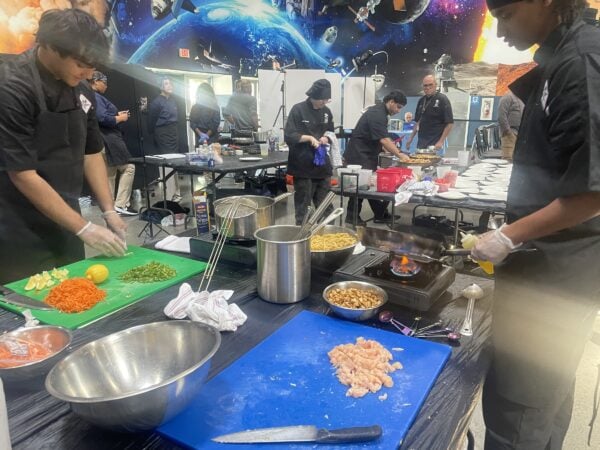 The presentations as well as the subsequent Q&A revealed a fascinating process for recipe development. Once presented with the theme—pasta—students had other parameters to consider. Just like a school meal, a space meal must meet strict nutrition guidelines, with calorie limits as well as limits on sodium content, sugar and fat, plus increased fiber content. According to NASA, the Johnson Space Center Food Lab food scientists developed these guidelines based on specific changes to the human body that occur in outer space:
- Increased fiber: Human GI function slows down tremendously in space; fiber supports healthy GI function.
- Sodium limits: To prevent creating extra edema (swelling due to excess fluid).
- Sugar limits: Limit non-nutrient calories for optimal health.
- Fats/saturated fats: Important for heart health and blood flow; heart health can change during space flight.
- Caloric requirements/limits: Astronauts are required to work out two hours a day in space to maintain their bone and muscle health. Caloric requirements and limits are set to optimize and support the astronauts’ physical health and wellness.
The Q&A was an opportunity for students to address how they handled the delicate balance of “nutrition vs. flavor” that school nutrition professionals know only too well. Every single team cited sodium limits as their main challenge. Several teams also spoke to the difficulty of calibrating spice levels; some spices can develop and get stronger over time, but the goal is to develop a flavor that stays consistent until the meal is ready to eat. You don’t want a meal to get spicier the longer it sits on the shelf, especially if that meal is meant to be shelf stable for up to a year (or more). The team from Pennsylvania used ginger to spice up their Pad Thai, while Maryland’s Beef Stroganoff incorporated arugula for a spicy kick (plus nutrients); the team from Massachusetts toasted the spices in their Pumpkin Pasta to help develop depth of flavor.
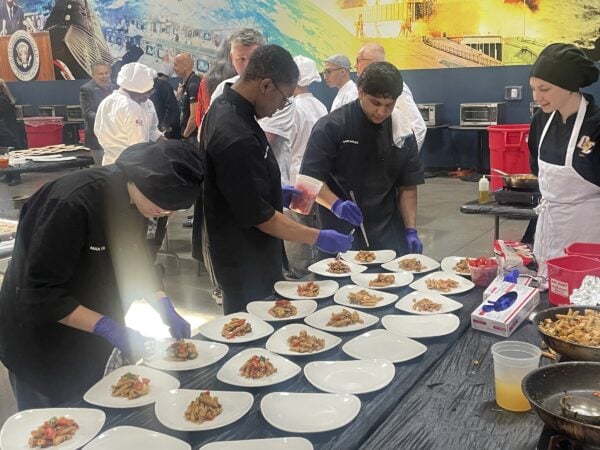 We also learned that some of the dishes were suitable to accommodate special diets. The Pennsylvania team’s Pad Thai was gluten-free and vegetarian, while the Zesty Spesto pasta salad from Arkansas was both Kosher and vegetarian. While some health/dietary restrictions might disqualify a person from going to space (think severe allergy or Celiac disease), NASA can accommodate diets with mild intolerances and allergies as well as religious/philosophical dietary preferences of their astronauts.
The teams fielded follow-up questions from the whole panel, but it was Chef Emmanuel Chavez and astronauts LaSarge and Parmitano who probed each team about the recipe development process as well as their approach to teamwork and leadership. For example:
- How many versions of this recipe did you test before you landed on this one?
- Why did you choose this pasta shape over another?
- What was the division of duties on your team?
- How did you delegate responsibility across team members?
- How did you decide on one preservation method over another?
Finalists displayed sharp marketing instincts in their presentations as well. Using words like “homemade” and “comforting,” teams framed their recipe development and flavor choices as an effort to bring the familiar flavors of home to the astronauts aboard ISS:
- Team Maryland described their Beef Stroganoff as “healthy and heartfelt.”
- Luxembourg used words like “home” and “warmth.”
- Florida described their linguine as “rustic” with “umami flavors.”
- Massachusetts’ Pumpkin Pasta was described as “homey” and “warm,” and the team directly referenced the flavors of American Thanksgiving.
If you weren’t hungry before these presentations, you were hungry by the end.
Space Taste: Preserving Food for Space Flight
There are two ways to preserve a meal going into space: thermostabilization or freeze-drying. As part of the recipe development process, each team had to decide how, and explain why, they wanted their dish preserved in a particular way for space.
“Thermostabilized” means that the food’s natural fluids remain in the bag—think soup or fruit cocktail. “Freeze-drying” involves removing all of a meal’s water content, which is then replaced once on-board ISS. The Massachusetts team envisioned their Pumpkin Pasta thermostabilized, for example, to better preserve the creaminess of the pumpkin sauce.
As it happens, a great deal of space food is produced in Texas—logical, given the proximity to NASA. Thermostablized foods are processed at Texas A&M University in College Station by JSC Food Lab scientists at the NASA Space Food Research Facility (SFRF). Food science and technology undergraduate and graduate students at the university get hands-on learning at the facility, working with NASA and foodservice contractor KBR to prepare foods for astronauts on the International Space Station. Freeze-dried food items are processed for spaceflight at the JSC Food Lab in Houston, where the HUNCH Culinary Challenge took place.
The Judges’ Table
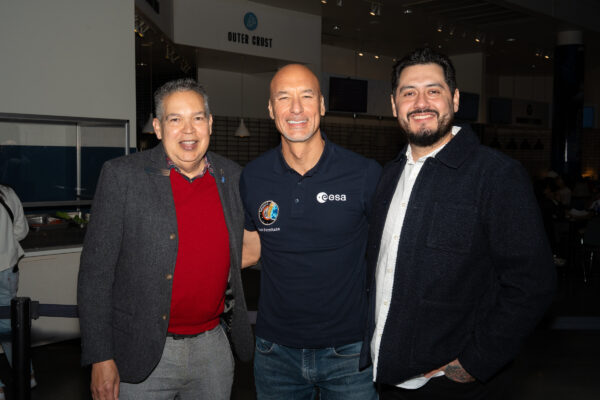
Left to right: William T. Harris, president and
CEO of Space Center Houston, with judges
Luca Parmitano and Emmanuel Chavez.
Chef Emmanuel Chavez
HUNCH Culinary Challenge guest judge, award-winning Houston Chef Emmanual Chavez of Michelin-starred restaurant Tatemó, reflected on his participation in the HUNCH Culinary Challenge and shared what surprised him the most about ‘space meals.’
- What appealed to you about participating as a guest judge?
It was a good opportunity to tap into the next generation of culinarians. We tend to forget that the sooner we guide the young generation, the better the path will be for them; they’ll have more clarity on the opportunities in this industry. It doesn’t have to be 17 hours behind the stove; it can be food science, a culinary teacher—there are so many other outlets. I would never have imagined being able to go NASA and get a private tour and then judge a cooking competition. It was an incredible experience from a personal perspective, just as I’m sure it was for the students to be a part of it.
- You told one of the teams that 90% of success in the food industry is energy, 10% is your recipes. Can you expand on that?
We get so stuck sometimes following recipes that we forget the people, that we’re in the hospitality industry. You’re probably going to make a bigger impact on your community and your career when you show up with the right energy, rather than focusing and getting really into detail on recipes. Anybody can cook, but how do you stand out? I tell my team all the time: show up with high energy, smile, say hi to everyone and treat them with respect because you never know who you are speaking to or the opportunities that might be in front of you.
- Did you learn anything that surprised you about space meals?
How very little salt or sodium can be used at all. That was a massive challenge. One of my biggest pet peeves is not seasoning, not salting as you cook, so tasting food that didn’t have much salt—I was a little confused at first! Learning about why [NASA] keeps the sodium levels low, that gave me another perspective and a new respect for our astronauts. It also made me realize how lucky we are to be able to taste food at its fullest.
- Were there any stand-out moments for you during the competition?
I remember the team from Luxembourg, and how composed and professional they seemed. I don’t think I got that polished until my late 20s! To see that generation being so passionate and confident. I can only imagine how incredible they are going to be—how all the contestants are going to be in the future.
Luca Parmitano
Luca Parmitano
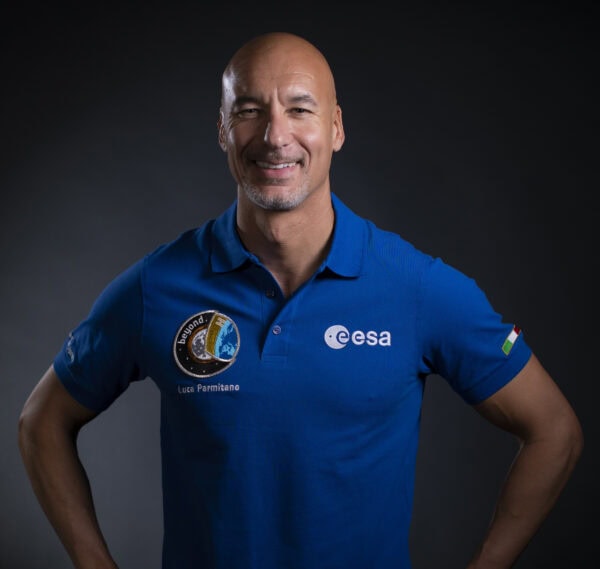
When Italian astronaut Luca Parmitano saw the HUNCH Culinary Challenge on his daily schedule, he wasn’t sure what to expect, but once he sat down at the judges’ table, he took his job seriously. Parmitano has completed two trips to the International Space Station (ISS) and made headlines in 2013 for almost “drowning in space” before recently adding culinary judge to his resume.
- How did you get involved with the HUNCH Challenge?
I saw this event on my schedule, and I had no idea or background [about it]. It was funny because this was a pasta event and I’m Italian. I thought maybe somebody at NASA thought, “Luca is Italian so he’s automatically a pasta expert!” Or it’s just [scheduling], and it just happened I was available.
- Are you a “pasta expert”?
I am absolutely not a pasta expert. I do cook pasta myself. I cook for my daughters. I am not what you’d call a “gourmet.” I have likes and dislikes, but I’m not a foodie. I grew up eating Italian meals and that means when you get up, you’re happy you’ve eaten. It tasted good, it was made from scratch and that’s what I know how to judge.
- Can you talk about a few moments of the HUNCH Culinary Challenge that stick out in your memory?
I thought that all of the presentations were amazing—all of them. I was so impressed, especially not being a cook myself and not having those skills, I thought those kids were simply outstanding in their approach, their enthusiasm, their abilities. These are ingenious kids that express their aptitudes in ways that are unconventional. We expect people in schools to do well in math, in science, in chemistry—and when I say we, I think about myself! I don’t think about the applications of those skills into an art like cooking. But they did! They demonstrated knowledge in microbiology, biology, in chemistry, because they were searching for ways to create a flavor or a texture [and] stay within the constraints of what they were assigned. I was simply blown away by that.
The dish I scored the highest, the team had created the flavor of Parmesan by using yeast instead. That way they could stay within the constraint of calories and salt. Their use of salt and pasta was simple, but it perfectly recreated the flavor they were aiming for. If they hadn’t told me, I would never have known. I thought, “This is applied chemistry,” and I was simply blown away.
I want to stress that these kids were very young. I hear too often [negativity] about “this generation.” Honestly, these kids are the demonstration that there’s no such thing as this generation being lazy; it all depends on what opportunities we give them—it really does. If we give them the opportunity to express themselves, they will do it and blow us out of the water in ways we have not imagined. I have a lot of respect and gratitude for what these kids teach me. My own daughters teach me something new every day in terms of compassion, capabilities, and the way of seeing the world in a different way.
*[Ed. note: Second Place winners Wekiva High School, Fla., used nutritional yeast to create the sauce for their Spicy Linguini with Creamy Mushrooms. Nutritional yeast is a popular substitute for Parmesan cheese because it mimics the nutty flavor of the cheese.]
- What can you share about the experience of eating in space?
Because I’m not a “gourmet” and because I value nutrition more than taste—let’s take that with a pinch of salt, like everyone else I enjoy eating good food! But my main driver, day-to-day, is how the nutrition affects me on a performance level, on a health level for keeping me fit. It’s a means to an end; it’s not an end unto itself.
When I’m in orbit, I like knowing that I can pick a meal from a variety of foods and adjust it to what I enjoy, knowing there isn’t a high level of salt, the calorie content is taken into consideration, all those things that matter to me have been taken into consideration [for me]. What I like is that it’s ready; I don’t have to think about making it.
I also had some Italian food made specifically for space. I understand not everybody is like me, and that people do [put more] value on the quality of texture and taste. A meal is also an experience, and sharing a meal is the most multicultural, intercultural experience, everywhere in the world. Social activities revolve around food.
When I saw there was Italian food on the [ISS] menu, but it doesn’t look or taste like Italian food that I know, I wanted to make that event something for my crewmates and show them what Italian food is supposed to look and taste like.
- When you get back from space what are the first foods you seek out?
It’s all the things we take for granted—fresh fruit. Fruit that spoils easily, for example bananas. You cannot refrigerate bananas, they brown. I eat basically one banana a day, but we don’t have bananas aboard, so I miss those.
I miss crunchy salad. Everything crunchy. Whether it’s fresh vegetables with that crunchy texture or even just crunchy food that doesn’t work in orbit because crunchy creates a lot of crumbs and crumbs tend to disperse in the atmosphere in orbit, so we don’t have a lot of crunchy things.
And, finally, a really good coffee. A good Italian coffee; nice and strong, and almost syrupy. A real espresso. I might not do it every day, but every once in a while, it’s so nice and in orbit you can’t have it.
Astronomical Results: We Have a Winner
The finalists left the 10th Annual HUNCH Culinary Challenge still in the dark, as NASA would not announce the winner until early May. While it may have felt like light-years to the contestants it was just five weeks to wait. Congratulations to the 2024-25 HUNCH Culinary Challenge winners, whose bold flavors and nutritious meals sent the judges’ panel into orbit:
- First Place: Phoebus High School, VA – Rasta Pasta
- Second Place: Wekiva High School, FL – Spinach Linguini with Creamy Mushrooms
- Third Place: RCTC, MI – Spicy Cajun Fettuccini with Roasted Veggies
If your school district has a culinary arts program and you want to learn more about the competition and how to enter, visit the HUNCH Culinary Challenge website (nasahunch.com/programs/culinary) where you will also find links to information on food engineering and food science, important new research, scholarships and more.


Related Articles